The Setting
Adam Pente, Michelle Burt, Brett Curtis, Jessica Jarrett-MacKillop, Adam Rogers
Muriel Spark was born in Edinburgh, Scotland on February 1st, 1918. At this time, the first Great War was just ten months away from armistice, but a new unforeseen threat was also rising out of the ashes. Benito Mussolini was coming to power in Italy, and some time later, Adolf Hitler was taking control of the NAZI party in Germany. This was the birth of Fascism in Europe, and Spark grew through her formative years during its rise. It is no wonder, then, that her best-known literary work was also set during this time of political strife throughout Europe. In The Prime of Miss Jean Brodie, Spark uses this time frame, and the political atmosphere surrounding it, to establish a central theme of Fascism in her novel, and how it relates to Miss Brodie's own method of teaching her girls.
By 1930 – the earliest date that the novel covers – Benito Mussolini had already achieved his complete dictatorship over Italy. He accomplished this task relatively easily, because Mussolini knew that if one controlled the flow of information, one could control the people. So, as he began his rise through politics, Mussolini made several reforms giving him complete control of the media, and allowing him to spread propaganda through any source he desired. It was also at this time that Adolf Hitler had begun his own road to power in Germany, utilizing tactics similar to Mussolini's, and eventually gaining complete control over Germany by 1934. These dates are significant, because by this time Muriel Spark was 16, the same age as the Brodie Set in her novel. Clearly, Spark was remembering this time in her life when she wrote The Prime of Miss Jean Brodie in 1962, crafting the character of Miss Brodie around the image of these fascist dictators.
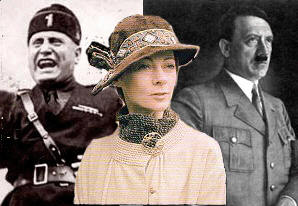
Benito Mussolini and Adolf Hitler
were the creators of fascist states and used not only propaganda but also sly
political calculations to control their respective countries. Both are mentioned
throughout the novel as, what seems to be idols of Miss Brodie. Mussolini,
Hitler and Miss Brodie all favored the idea of total power over a group of
people; in Mussolini and Hitler's case it was their citizens and in Miss
Brodie’s case it was her pupils, the Brodie set. "It occurred to Sandy, there at
the end of the Middle Meadow walk, that the Brodie set was Miss Brodie’s
fascisti, not to the naked eye, marching along, but all knit together for her
need and in another way, marching along."(pg.31)
Similar to Mussolini and Hitler’s
control over their countries, Mrs. Brodie had control over the girls who she
taught. Her teaching styles related to the two dictators in that she pushed her
“propaganda” on the girls. Along with that all three used shrewd calculations to
acquire what they desired but Miss. Brodie's plans for her "group of fascist"
was on a much smaller scale then Mussolini and Hitler.
When her "set" had graduated into the senior school Miss. Brodie worried that her power and teachings would be lost on the girls. "Miss Brodie had a hard fight of it during those first few months when the senior school had captivated her set, displaying as she did the set that capacity for enthusiasm which she herself implanted. But having won the battle over team spirit, she did not despair." (Sparks, pg 83). Miss. Brodie carefully thought it through and had decided that since the teachers at the senior school seemed to have no problems with her set that she would not apply a direct attack on them to the girls, perhaps causing alienation. This is a perfect example of Miss. Brodie's calculating nature in order to maintain her power over the girls.
Growing up during the height of Fascism’s control clearly had a great effect Muriel Spark, and, as demonstrated above, this is most evident in The Prime of Miss Jean Brodie. The doctrines of Fascism are very evident throughout the novel, most of all in Miss Brodie’s method of teaching her girls. She, like the European dictators she admired, taught with charisma and pushed her own propaganda onto her students, controlling the knowledge they were taught to develop the girls to suit her own views. And she, like the dictators of Germany and France, was defeated.