 For this section of the hypermedia project, I shall explicate specifically the work itself, with a view to elucidating the role of the language and imagery, and offering a better understanding of the poem, and its motive. But first, in explicating the work as a whole, it's rewarding to take note of The Flea's structure. For this section of the hypermedia project, I shall explicate specifically the work itself, with a view to elucidating the role of the language and imagery, and offering a better understanding of the poem, and its motive. But first, in explicating the work as a whole, it's rewarding to take note of The Flea's structure.
The poem deals with the unification of a couple by shared parasitic experience – the flea that has unified both their bloods, and therefore their bodies, in its "walls of jet". This intermingling of the bloods inside the Flea is in part representative of the 17th century medical belief (before the invention of the microscope enlightened the scientific populace to the existence of male sperm) that successful coitus was reliant on the exchanging and mixing of bodily fluids. And so the metaphor stems from - and the narrator insists on the coitus being pre-empted by - the couple’s fluids having already been joined in parasitic matrimony.
It's interesting how the this overarching theme in the poem, that of the duo as unified by a third, manifests in various places throughout its structure. 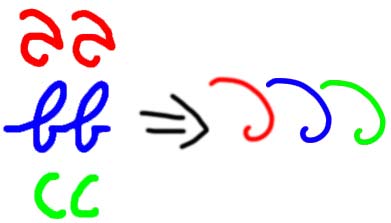 The theme of the trio is echoed in the simple division of the poem into three stanzas. Furthermore, the rhyme scheme of the poem (AA, BB, CC, DDD) suggests each of the poems trio (A, B, and The theme of the trio is echoed in the simple division of the poem into three stanzas. Furthermore, the rhyme scheme of the poem (AA, BB, CC, DDD) suggests each of the poems trio (A, B, and C) being brought together in the rhyming triplet at the end with the suggestion of a unified conclusion. Adding to this, the margin indentation of the last triplet accentuates the concluding unity of each stanza. It appears to provide a structural conclusion that echoes unifying theme of the poem, and snaps each stanza closed into a trio, much in the same manner as Shakespeare would snap his sonnets closed with a rhyming couplet. C) being brought together in the rhyming triplet at the end with the suggestion of a unified conclusion. Adding to this, the margin indentation of the last triplet accentuates the concluding unity of each stanza. It appears to provide a structural conclusion that echoes unifying theme of the poem, and snaps each stanza closed into a trio, much in the same manner as Shakespeare would snap his sonnets closed with a rhyming couplet.
The poem is simply littered with threes, to mirror the trichotomous relationship. However, it isn’t contained solely in the structure - it is extended even to the point of comedic irony that the word three itself is mentioned three times.
However, enough of structure: let's look directly at the poem itself.
It begins:
MARK but this flea, and mark in this,
The immediate exclamation to “MARK” invites the reader into the poem with the sudden and unnerving command that we must immediately regard a specific entity – the flea. The following echoed command that we “mark [in] this” instructs us that our attention is being drawn for a reason – this flea contains (pun mildly intended) something. So from the very first line Donne constructs the conceit that will continue to poems conclusion: whatever is "in" this flea is crucial to the poem. Yet the opening line - from the capitalisation, and the initial stark command - the poem is introduced to the reader as a forceful and immediate entity, and the command itself - being relayed to the female - appears as an interjectionary request. There is no element of coercion, instead blunt command.
How little that which thou deniest me is ;
Swiftly we’re told that what is in the flea is nothing less than that which the male speaker is being denied. The initial ambiguity of the "that", which is so "little", is almost a request for symathy on the part of the male speaker, and a clamouring for his sense of reasoning to be adopted.
It suck'd me first, and now sucks thee,
And in this flea our two bloods mingled be.
Thou know'st that this cannot be said
A sin, nor shame, nor loss of maidenhead ;
Yet this enjoys before it woo,
It is at the third line in the poem that we're introduced to the sexual nature of the flea, and the the imagery that contextualises the previous two lines, and their request. This flea has "suck'd" both man and woman, and it has now unified their blood as one. Yet interestingly, the "this" of "Thou know'st that this cannot be said" contains a definite ambiguity. What is "this"? The allusion that it is the intermingling of their bloods is quite straight forward, yet the sexualised repetition of the act of being "suck'd" suggests that it may be the suggestively erotic act of being sucked upon, that is not sinful nor shameful. Susannah Mintz argues in "Forget the Hee and Shee": Gender and Play in John Donne" that the usage of the long 's' of the period, means that word itself may be a literal allusion to "fucks". This act of this sucking (or fucking) having happened to the male first, but being an experience shared by both, promotes an idea that - in embellishment - calls to mind two successful hits of cupid's arrow.
Yet our flea is a very participatory cupid. And a foward one at that - our male despairs that it need not even "woo" her - nor engage in courtship - for the pleasures of her skin, and that which lies underneath it.
And pamper'd swells with one blood made of two ;
And this, alas ! is more than we would do.
This pseudo-sexual involvement of the flea is here contextualised by the male speaker as a form of luxury. It is to be "pamper'd" to exist with both of their bloods unified. Suggesting that the speaker has either elevated the female in status, and seeks to engage with the luxury of unity with her, or simply that the luxury is in the unification.
Further, the reference to the parasite that “swells with one blood made of two” is profound in its phallic suggestion and imagery. The entire first stanza is rife with an assertive male sexuality - first contextualised within the initial immediacy of the "MARK", and asserted further by the allusion of a sexual enjoyment within the the act of being "suck'd", and the powerful imagery of the "bloods mingled". The first stanza throbs - literally - with a bodily quality. The power appears to promote the male as forcing himself on the female, whilst enraptured, and barely containing his lust.
O stay, three lives in one flea spare,
Where we almost, yea, more than married are.
This flea is you and I, and this
Our marriage bed, and marriage temple is.
The second stanza begins with a similarly powerful exclamation of "O", which contains within a suggestion of both despair and sexual frustration. However, the speaker's approach begins on a completely inverted note, not of asking the female to appreciate the life and the unifying ability of the flea, but 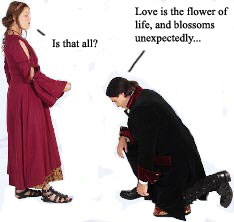 simply not to kill it. It has become – or so he suggests – a holy church, in which their marriage has been enacted. Donne here lambastes the speaker with such a hyperbolised promotion of the metaphor, as to assert its comedy. The internal organs of a flea now are church, priest, and every act that leads to them standing before the bed, awaiting consummation. But humorously, with the declaration that “[t]his flea is you and I”, realised alongside the clear motive of the speaker, the entire relationship between the two characters is relegated to being one of an entirely superficial and sexual nature. There is no question of courtship, it appears, in his defining their coupling by their intermingled fluids. The “you and I” that he longs for, is simply a sexual one. simply not to kill it. It has become – or so he suggests – a holy church, in which their marriage has been enacted. Donne here lambastes the speaker with such a hyperbolised promotion of the metaphor, as to assert its comedy. The internal organs of a flea now are church, priest, and every act that leads to them standing before the bed, awaiting consummation. But humorously, with the declaration that “[t]his flea is you and I”, realised alongside the clear motive of the speaker, the entire relationship between the two characters is relegated to being one of an entirely superficial and sexual nature. There is no question of courtship, it appears, in his defining their coupling by their intermingled fluids. The “you and I” that he longs for, is simply a sexual one.
Though parents grudge, and you, we're met,
And cloister'd in these living walls of jet.
Here the speaker acknowledges his conquests hesitancy, and their conflict. He urges that although she grudges, she should realise that they’re already married and “met” in the living walls of the small black flea. Interestingly, however, the suggestion appears to be that this is not the first time he has me this lady. "Though parents grudge" implies that he's a known character - whether a philanderer or a naive young male - and he has fostered somewhat of a bad reputation with her parents. Could it be that the flea is simply one of his many devices, in his many attempted wooings, used to try and consolidate their union in the eyes of the female?
Though use make you apt to kill me,
Let not to that self-murder added be,
And sacrilege, three sins in killing three.
The second stanza concludes with a similar request that the female refrain from killing, and the tone is a stark contrast to the empassioned and engorged suggestion of the first stanza. The speaker has moved from definite assertion to a definsive position, whereby he is maintaining that to kill the flea, and so their union, would be for the female to harm herself. Instead of the powerful symbolism of the "bloods mixed" we have the de-sexualised act of their union now being "cloister'd", and the assertiveness of his sexuality appears to be suffering from being constantly dismissed. The speaker is relegated from the empassioned and bodily assertion in the first stanza, to adopting a simple request to not be "killed" in the second, and so his passion appears to be being siphoned off by the females constant rebuttals.
Cruel and sudden, hast thou since
Purpled thy nail in blood of innocence?
Wherein could this flea guilty be,
Except in that drop which it suck'd from thee?
Yet thou triumph'st, and say'st that thou
Find'st not thyself nor me the weaker now.
' Tis true ; then learn how false fears be ;
Just so much honour, when thou yield'st to me,
Will waste, as this flea's death took life from thee.
In the third stanza, the poem’s momentum distances itself further from the immediate command of the “MARK”. It appears to have wilted entirely. The only "blood" now is the smear resulting from the killing of the unifying flea. The speaker appears fully distanced from the erstwhile passion, and instead acquainted with the death that has resulted from his initial drive for union. Now “[c]ruel and sudden” has his beloved become, for her "three sins in killing three". Donne even has the narrator absurdly refer to the flea as embodying pure “innocence”. But the third party has been eradicated, and the only mention of the unifying bodily fluid is of the “purpled” nail - the defamiliarised 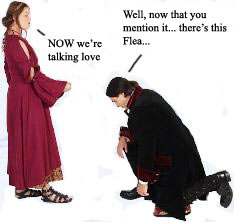 (and de-eroticised) result of the flea’s death. No longer a bodily fluid, merely a coloured stain. No more is the poem swollen with intermingled blood of their bodies, instead its prospect for coitus has become absent, or limp. (and de-eroticised) result of the flea’s death. No longer a bodily fluid, merely a coloured stain. No more is the poem swollen with intermingled blood of their bodies, instead its prospect for coitus has become absent, or limp.
At the quashing of the prospect of sex, the reader is shown how ambitious and naïve the narrator was in his first proposals. The female protagonists in killing the flea has triumphed, and been an unwavering asserter of her own desires - not to be persuaded or coerced. She ultimately rejects the symbolism of the flea completely. Yet more than this - she mocks it's usage as a metaphor for their union, gladly killing it despite the speaker's proclaiming that she will sin in doing so. She “[f]ind’st not thyself nor me the weaker” – both the flea's life, and its death, have been - in her eyes - inconsequential.
Yet the poem ends without a decisive answer. The assertiveness of the speaker concludes the poem, with one final request for a now flealess union. The conceit is concluded with the speaker realising himself that the flea played no necessary role - in life, it was a metaphor, in death, incorporated into a new assertion - that her honour shall be unharmed either way. It appears that the speaker is relentless, in his pursuit. When his assertion of her intact honour is exhausted - with a similar rejection - one cannot but expect he shall endeavour to win her affections by some other conceit, or action, and that her parents - and indeed her - shall continue to begrudge his attempts. One thing, however, seems certain - that any of his future endeavours will most likely remain as charming as the last, which is not that charming at all.
|