The Earth, Moon and Mercury Comparison
Astronomy 1
Lecture Notes
Monday, November 2, 1998
READ: Text Chapter (Chaisson and McMillan) # 8 The Moon and Mercury
Astronomical Events
Wednesday, Nov 4, 1998
- Full Moon
- Moon at Perigee
- High Tides
Last Lecture: (subjects yet to be covered)
Physical Properties of the Earth, Moon and Mercury
Cratering - Process, Timing, Age Judgement
Process:
v ~ 30 km/s
20 m diameter object
m ~ 107 kg Energy ~ 1017 Joules
vaporization of object + shock wave
compression and decompression of surface
Crater diameter ~ 10 x diameter of object
Crater depth ~ 1/5 crater diameter
eg. 20m object --> ~200 m diameter crater, ~40 m deep
much larger fracture zone beneath
History of the Moon:
Molten and differentiation --> highlands
Cratering decreasing with time
Late, Heavy cratering at 700 million years
Lava Flow to form Maria of dark basaltic rock
Later cratering
Origin of Moon
1. Small Iron (core)
2. Rocks show few volatiles
3. Different from Earth
Earth Moon Mercury
Radius 6378 1738 2440 km
1 0.27 0.38 R(Earth)
Mass 6x1024 7.4x10²² 3.3x10²³ kg
1 1/81 1/18
density 5500 3300 5400
R(core) 3500 200 1800
V(core) 0.16 0.0015 0.4 fraction of planet volume
Mass(core) 0.32 0.04 0.6 fraction of planet mass
Magnetic Field 1 0 0.01 fraction of Earth
Escape Velocity 11.2 2.4 4.3 km/s
g 9.8 1.6 3.7 m/s2
Atmosphere 1 none 1x10-12
N, O Na, K
Rot. Period 1 day 27.3 day 58.65 days
Surface T ~ 283 K 103-383 k 88-700 K
Axial Tilt 23.5 1.5 0
Surface Eroded Cratered Cratered
----------------------
Viewing the Moon - its Orbit and Rotation:
Rotation = Revolution (Same Face to the Earth all the time) = 27.3 days
Libration allows us to see 59% of surface
1. North and South +/- 6.5 degrees due to axial tilt of 1.5 degrees
and 5 degree tilt of its orbit
2. East West +/- 7 degrees because of eccentricity of Orbit (e = 0.055)
(constant rotation but no constant velocity in orbit)
3. Parallax from Earth (small effect)
----------------------
Radar Ranging for the rotation rate of Mercury
Surface features can not be seen from Earth visually,
and not rotation can be seen that way.
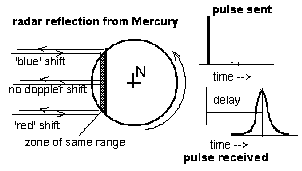 Note: There are a range of delays of the return of the radar.
Time of travel to Mercury and Back 2x(0.61 AU) = 2x305 s = 610 s = 10 minutes
Shortest delay - Spot in the center of Mercury's disk
Longest delay - Ring at the edge of Mercury's disk
Range of delay = time of travel of Mercury's diameter (4880 km)
= 16 milliseconds
Doppler Shift at each delay gives rotation rate as shown in figure above
Maximum Surface Speed = 0.003 km/s
Maximum Doppler Shift = v/c = 0.003/300,000 = 10-8
for f = 3 GHz = 3x10⁹
shift = 30 Hz
Note: There are a range of delays of the return of the radar.
Time of travel to Mercury and Back 2x(0.61 AU) = 2x305 s = 610 s = 10 minutes
Shortest delay - Spot in the center of Mercury's disk
Longest delay - Ring at the edge of Mercury's disk
Range of delay = time of travel of Mercury's diameter (4880 km)
= 16 milliseconds
Doppler Shift at each delay gives rotation rate as shown in figure above
Maximum Surface Speed = 0.003 km/s
Maximum Doppler Shift = v/c = 0.003/300,000 = 10-8
for f = 3 GHz = 3x10⁹
shift = 30 Hz
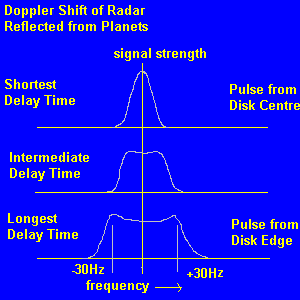 The diagram above shows the frequency distribution of three radar pulses
reflected from Mercury with three different delay times. The longest
delayed pulse is from the edge of the disk and has the most Doppler
shift in it and reveals the rotation speed of Mercury.
-----------------------
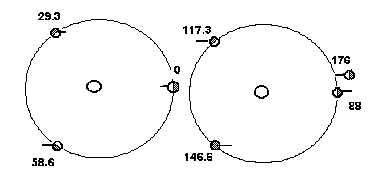
Rotation of Mercury 58.65 versus revolution of 88.0 days
= exactly 2/3 of a Mercury year.
In 2 revolutions, Mercury rotates exactly 3 times. So it shows the same
face to the Sun at every perihelion --> Hot spots on the equator on
opposites sides of Mercury - at the equator
The diagram above shows the frequency distribution of three radar pulses
reflected from Mercury with three different delay times. The longest
delayed pulse is from the edge of the disk and has the most Doppler
shift in it and reveals the rotation speed of Mercury.
-----------------------
Rotation of Mercury 58.65 versus revolution of 88.0 days
= exactly 2/3 of a Mercury year.
In 2 revolutions, Mercury rotates exactly 3 times. So it shows the same
face to the Sun at every perihelion --> Hot spots on the equator on
opposites sides of Mercury - at the equator
 Cause of 'locking' of rotation with revolution:
1. Orbit of Mercury is very eccentric (e = 0.206)
It is 50% farther away at aphelion than perihelion
2. Tides vary as the inverse cube of the distance
Tides are 3.5 times stronger from the Sun at
perihelion than aphelion. (1.52)3 = 3.5
3. Mercury density is not exactly isotropic
ie. it is not uniform in all directions
4. Result: Angular movement in orbit at perihelion =
Rotation Rate = 6.1o/day
Revolution around the Sun at Perihelion = 6.3o/day
Revolution around the Sun at Aphelion = 2.8o/day
----------------------
Relative Size and Intensity of the Sun at Mercury
Cause of 'locking' of rotation with revolution:
1. Orbit of Mercury is very eccentric (e = 0.206)
It is 50% farther away at aphelion than perihelion
2. Tides vary as the inverse cube of the distance
Tides are 3.5 times stronger from the Sun at
perihelion than aphelion. (1.52)3 = 3.5
3. Mercury density is not exactly isotropic
ie. it is not uniform in all directions
4. Result: Angular movement in orbit at perihelion =
Rotation Rate = 6.1o/day
Revolution around the Sun at Perihelion = 6.3o/day
Revolution around the Sun at Aphelion = 2.8o/day
----------------------
Relative Size and Intensity of the Sun at Mercury
 Poles of Mercury are cold (no tilt of the rotation axis)
