Supplementary Notes on Mars - Not Covered in any lecture (1998):
(Lecture for Nov 12, 1997)
Mars - Surface Features and Planetology
Chaisson and McMillan Chapter #10
LECTURE
Surface Features (from Viking orbiters)
History of Exploration of Mars
Mariner 4 1965
Mariner 6, 7 1969
Mariner 9 1971 Orbiter that mapped to resolution of 1 km
Viking Orbiters 1976 Mapped entire globe to resolution of 20 m
Viking 1 lander worked until 1982
Viking 2 lander worked until 1980 - Life exp.
Mars Global Explorer
1997 Pathfinder mobile robot sampled rocks
Lander design for 30 days (lasted 90) 16000 images
Rover designed for 7 days (lasted 84) 550 images 15 rock analyses
Mars Surveyor 1998-9 Two launches, orbiter and lander, look at climate history
see BELOW for preliminary results from http://mars.jpl.nasa.gov/
Features
ICE CAPS
Permanent: (CO2 becomes dry ice at <150 K)
Northern ~ 1000 km Water
Southern ~ 350-500 km Dry Ice
(no water detected but may be there)
Strong wind in northen hemisphere during warmer
southern summer deposit dust on the northern ice cap
--> dust on icecap in northern summer sublimates
the dry ice leaving the water.
(Sand Dunes Seen in northern polar regions deposited
by dust storms)
Sand is very fine - only 1/1000 mm in size and easily moved
by Mars storms
Valleys --> from sunlight sublimation and melting
Layered deposits --> dust and ice from a cycling climate
TOPOGRAPHY
Two distinct Hemispheres: Division 30 degrees to equator - sharp boundary
Northern Hemisphere --> Volcanic Plane with few craters
Younger ~ 3 billion years - lowered and flooded with lava (how????)
Two Huge Bulges 1. Elysium Planitia (5 km high w/2 volcanoes)
2. Tharsis Bulge (twice and big and high)
Line of three volcanoes
Plus Olympus Mons on NW edge
Age ~ 2-3 billion years
fewer craters than rest of hemisphere
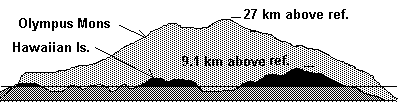 Southern Hemisphere --> Highlands 2-3 km above reference - heavily cratered
Older ~ 4 billion years
Two Large Impact regions
1. Hellas
2. Argyre
Crater Ejecta more liquid looking than on the Moon (Sub-surface water?)
Tectonic Fractures
Surround Tharsis Bulge (Crustal Forces - Cracks)
Valles Marineris (120 km wide, 7km deep, 4000 km long)
Tharsis Bulge to Southern Hemisphere
Runoff Channels
In Equatorial Region probably from flow from highlands into the northern plain
Enormous Flow rates >> flow of Amazon river
~ 3 billion years ago = time of formation of northen plain
History
4 billion years ago - climate changed as atmosphere changed
Mars cooled to freeze all the water in the permafrost
3 billion years ago - volcanic activity heated regions of the surface
flash floods -
runoff channels formed.
water refroze in the subsurface
Search for Life
Search for Life (Viking 2 at Utopia Planitia)
1. Inorganic Chemistry = x-ray fluorescence
Rocks 45% SiO2, 18% Fe2O3
2. Molecular Analysis (No organics found)
Volatization
Pyrolysis
Gas Chromotography
3. Biology
(a) Label Release 14C in Formate, Glycolate, Glycine, Alamine, Lactate
Look for isotope in CO2
Saw a reaction - later found to be due to chemical reaction with
Peroxides in the soil (produced by UV light on soils)
(b) Gas Exchange 18O in Water added to the soil
Again there was a reaction with the peroxides which gave an
positive result
Meteors from Mars (1997)
Orange-colored carbonate mineral globules found in a meteorite,
called ALH84001, believed to have once been a part of Mars. These
carbonate minerals in the meteorite are believed to have been formed
on Mars more than 3.6 billion years ago. Their structure and chemistry
suggest that they may have been formed with the assistance of primitive,
bacteria-like living organisms. A two-year investigation by a NASA research
team found organic molecules, mineral features characteristic of biological
activity and possible microscopic fossils inside of carbonate minerals
such as these in the meteorite. While these studies did not yield convincing
proof that life must have been present early in the history of Mars, the
results are consistent with that interpretation.
Several unusual tube-like structural forms that are less than 1/100th the
width of a human hair in size. The structures were found in meteorite
ALH84001, one of several "SNC"-type meteorites believed to be of Martian
origin. The structures are very similar in size and shape to extremely tiny
microfossils found in some Earth rocks. Although this structure is not part
of the research published in the Aug. 16, 1996 issue of the journal Science,
it is located in a similar carbonate glob in the meteorite. This structure
will be the subject of future investigations that could confirm whether or
not it is fossil evidence of primitive life on Mars 3.6 billion years ago.
------------------------------------------------------------------------------
Nov 4, 1997
Scientific highlights of the Mars Pathfinder mission are:
Martian dust includes magnetic, composite particles, with a mean size
of one micron.
Rock chemistry at the landing site may be different from Martian
meteorites found on Earth, and could be of basaltic andesite composition.
The soil chemistry of Ares Vallis appears to be similar to that of the
Viking 1 and 2 landing sites.
The observed atmospheric clarity is higher than was expected from
Earth-based microwave measurements and Hubble Space Telescope observations.
Dust is confirmed as the dominant absorber of solar radiation in Mars'
atmosphere, which has important consequences for the transport of
energy in the atmosphere and its circulation.
Frequent "dust devils" were found with an unmistakable temperature, wind and pressure
signature, and morning turbulence; at least one may have contained dust (on Sol 62), suggesting
that these gusts are a mechanism for mixing dust into the atmosphere.
Evidence of wind abrasion of rocks and dune-shaped deposits was found, indicating the
presence of sand.
Morning atmospheric obscurations are due to clouds, not ground fog; Viking could not
distinguish between these two possibilities.
The weather was similar to the weather encountered by Viking 1; there were rapid pressure
and temperature variations, downslope winds at night and light winds in general. Temperatures
were about 10 degrees warmer than those measured by Viking 1.
Diversity of albedos, or variations in the brightness of the Martian surface, was similar to other
observations, but there was no evidence for the types of crystalline hematite or pyroxene
absorption features detected in other locations on Mars.
The atmospheric experiment package recorded a temperature profile different than expected
from microwave measurements and Hubble observations.
Rock size distribution was consistent with a flood-related deposit.
The moment of inertia of Mars was refined to a corresponding core radius of between 1,300
kilometers and 2,000 kilometers (807 miles and 1,242 miles).
The possible identification of rounded pebbles and cobbles on the ground, and sockets and
pebbles in some rocks, suggests conglomerates that formed in running water, during a warmer
past in which liquid water was stable.
Southern Hemisphere --> Highlands 2-3 km above reference - heavily cratered
Older ~ 4 billion years
Two Large Impact regions
1. Hellas
2. Argyre
Crater Ejecta more liquid looking than on the Moon (Sub-surface water?)
Tectonic Fractures
Surround Tharsis Bulge (Crustal Forces - Cracks)
Valles Marineris (120 km wide, 7km deep, 4000 km long)
Tharsis Bulge to Southern Hemisphere
Runoff Channels
In Equatorial Region probably from flow from highlands into the northern plain
Enormous Flow rates >> flow of Amazon river
~ 3 billion years ago = time of formation of northen plain
History
4 billion years ago - climate changed as atmosphere changed
Mars cooled to freeze all the water in the permafrost
3 billion years ago - volcanic activity heated regions of the surface
flash floods -
runoff channels formed.
water refroze in the subsurface
Search for Life
Search for Life (Viking 2 at Utopia Planitia)
1. Inorganic Chemistry = x-ray fluorescence
Rocks 45% SiO2, 18% Fe2O3
2. Molecular Analysis (No organics found)
Volatization
Pyrolysis
Gas Chromotography
3. Biology
(a) Label Release 14C in Formate, Glycolate, Glycine, Alamine, Lactate
Look for isotope in CO2
Saw a reaction - later found to be due to chemical reaction with
Peroxides in the soil (produced by UV light on soils)
(b) Gas Exchange 18O in Water added to the soil
Again there was a reaction with the peroxides which gave an
positive result
Meteors from Mars (1997)
Orange-colored carbonate mineral globules found in a meteorite,
called ALH84001, believed to have once been a part of Mars. These
carbonate minerals in the meteorite are believed to have been formed
on Mars more than 3.6 billion years ago. Their structure and chemistry
suggest that they may have been formed with the assistance of primitive,
bacteria-like living organisms. A two-year investigation by a NASA research
team found organic molecules, mineral features characteristic of biological
activity and possible microscopic fossils inside of carbonate minerals
such as these in the meteorite. While these studies did not yield convincing
proof that life must have been present early in the history of Mars, the
results are consistent with that interpretation.
Several unusual tube-like structural forms that are less than 1/100th the
width of a human hair in size. The structures were found in meteorite
ALH84001, one of several "SNC"-type meteorites believed to be of Martian
origin. The structures are very similar in size and shape to extremely tiny
microfossils found in some Earth rocks. Although this structure is not part
of the research published in the Aug. 16, 1996 issue of the journal Science,
it is located in a similar carbonate glob in the meteorite. This structure
will be the subject of future investigations that could confirm whether or
not it is fossil evidence of primitive life on Mars 3.6 billion years ago.
------------------------------------------------------------------------------
Nov 4, 1997
Scientific highlights of the Mars Pathfinder mission are:
Martian dust includes magnetic, composite particles, with a mean size
of one micron.
Rock chemistry at the landing site may be different from Martian
meteorites found on Earth, and could be of basaltic andesite composition.
The soil chemistry of Ares Vallis appears to be similar to that of the
Viking 1 and 2 landing sites.
The observed atmospheric clarity is higher than was expected from
Earth-based microwave measurements and Hubble Space Telescope observations.
Dust is confirmed as the dominant absorber of solar radiation in Mars'
atmosphere, which has important consequences for the transport of
energy in the atmosphere and its circulation.
Frequent "dust devils" were found with an unmistakable temperature, wind and pressure
signature, and morning turbulence; at least one may have contained dust (on Sol 62), suggesting
that these gusts are a mechanism for mixing dust into the atmosphere.
Evidence of wind abrasion of rocks and dune-shaped deposits was found, indicating the
presence of sand.
Morning atmospheric obscurations are due to clouds, not ground fog; Viking could not
distinguish between these two possibilities.
The weather was similar to the weather encountered by Viking 1; there were rapid pressure
and temperature variations, downslope winds at night and light winds in general. Temperatures
were about 10 degrees warmer than those measured by Viking 1.
Diversity of albedos, or variations in the brightness of the Martian surface, was similar to other
observations, but there was no evidence for the types of crystalline hematite or pyroxene
absorption features detected in other locations on Mars.
The atmospheric experiment package recorded a temperature profile different than expected
from microwave measurements and Hubble observations.
Rock size distribution was consistent with a flood-related deposit.
The moment of inertia of Mars was refined to a corresponding core radius of between 1,300
kilometers and 2,000 kilometers (807 miles and 1,242 miles).
The possible identification of rounded pebbles and cobbles on the ground, and sockets and
pebbles in some rocks, suggests conglomerates that formed in running water, during a warmer
past in which liquid water was stable.