Astronomy 1 - November 16, 1998
Introduction to Jupiter
Text Chapters (Chaisson) = #11
Extra Material on Mars - Supplementary
Quiz Today
NOTICES: New Moon - Thursday 19th November
Leonid Meteor Shower (November 17-18) Wednesday evening
Radiant in Leo which rises 2 am
(Comet Tempel-Tuttle passed Earth Orbit March 1998
and left debris along its path)
Possible Storm of meteors - depends on distribution of debris
Normal 60/hr and 71 km/s speed
Meteor Storm in 1966 of 150,000 in 1 hr
Occurs about every 33 years
Peak storm predicted at 19 hr UT, Nov 18 = 15 hr AST (3 pm = daytime)
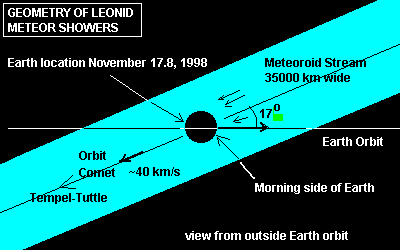 BEST TIME to observe showers is after midnight
ie. Tuesday morning, Nov 17. (and if clear Wednesday morning, Nov 18)
POST LEONIDS - Description of the Shower seen Tuesday Morning
-----------------------------------------------
BEST TIME to observe showers is after midnight
ie. Tuesday morning, Nov 17. (and if clear Wednesday morning, Nov 18)
POST LEONIDS - Description of the Shower seen Tuesday Morning
-----------------------------------------------
LECTURE
JUPITER:
Physical Parameters
Distance: 5.203 AU
Eccentricity 0.0484 (5.455AU to 4.951 AU)
inclination 1o 18' [We see the equator edge on]
Period 11.9 yr
(Synodic Period = 1.092 years = 1 year 34 days)
Diameter 142,800 km = 11.2 R(earth)
Mass 318 M(earth)
Ave.Density 1,340 kg/m3 Not Rock which has density 2,500-3,000 kg/m3
Rotation 9h 50m (longer period nearer the poles 9h 56m)
Differential Rotation of Gas
Axis Tilt 3o5' NO SEASONS
Magnetic Field 14 x Earths (4 Gauss at cloud tops)
Dipole tilted 10o to rotation axis
Escape Velocity = 61 km/s
Albedo 0.51
Oblateness 0.0637 (Oblate Spheroid - determines size of the Core
The mass of the core gives much of the gravity)
A pure gas ball would be more oblate!!!
Temperature (Cloud Tops) 150 K max
Effective Temperature = 124 K
(determined from the amount of thermal radiation emitted
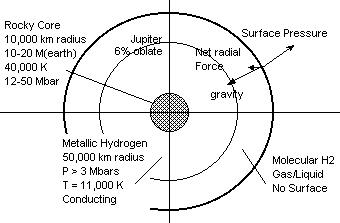 Pressure and Hydrostatics
Pressure = Force/Area
Equilibrium: Weight of gas = Area x (Pressure below - Pressure above)
or Density x gravity = Pressure Gradient (Newtons/m3)
Radiation Balance:
Solar Radiation = 1340 W/m2 /(5.2)2 = 49.6 W/m2
Area = (pi)R2 = 1.60x10¹⁶ m2
Energy absorbed = 0.5 (1.60x10¹⁶ m2)49.6 W/m2 = 4.05x10¹⁷ W
T4 = F/(4(pi)R2s) =4.05x10¹⁷W/5.67x10-8 /6.4x1016m2 = 7.14x1024
= 1.112x10⁸ K4
T = 103 K (Actually 109 K)
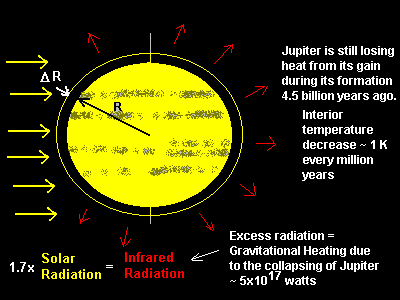
Actual Radiation = (124/109)4 Expected Radiation =1.7 x Expected
There is more radiation coming from Jupiter than it gets from the Sun!!!
Gravitational Energy:
Gravitational potential Energy is inversely proportional to
the radius of the planet - But as it collapses that energy is
changed to heat and pressure of the interior which acts to keep
the planet from collapsing. As the heat gradually escapes, the
planet collapses. Jupiter is still undergoing that process.
Pressure and Hydrostatics
Pressure = Force/Area
Equilibrium: Weight of gas = Area x (Pressure below - Pressure above)
or Density x gravity = Pressure Gradient (Newtons/m3)
Radiation Balance:
Solar Radiation = 1340 W/m2 /(5.2)2 = 49.6 W/m2
Area = (pi)R2 = 1.60x10¹⁶ m2
Energy absorbed = 0.5 (1.60x10¹⁶ m2)49.6 W/m2 = 4.05x10¹⁷ W
T4 = F/(4(pi)R2s) =4.05x10¹⁷W/5.67x10-8 /6.4x1016m2 = 7.14x1024
= 1.112x10⁸ K4
T = 103 K (Actually 109 K)
Actual Radiation = (124/109)4 Expected Radiation =1.7 x Expected
There is more radiation coming from Jupiter than it gets from the Sun!!!
Gravitational Energy:
Gravitational potential Energy is inversely proportional to
the radius of the planet - But as it collapses that energy is
changed to heat and pressure of the interior which acts to keep
the planet from collapsing. As the heat gradually escapes, the
planet collapses. Jupiter is still undergoing that process.
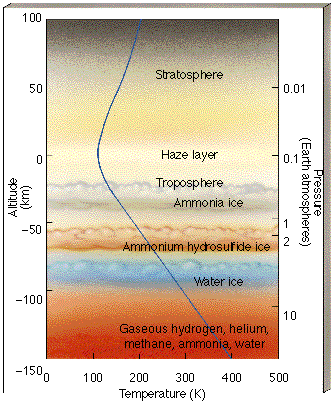
 Atmosphere: (Gaseous Part of Atmosphere = 1000 km thick
H2 95.5%
He 4.4 %
CH4 0.09 %
NH3 0.02 %
H20 0.01 %
Traces of ethane, acetylene, phosphine,
Atmosphere: (Gaseous Part of Atmosphere = 1000 km thick
H2 95.5%
He 4.4 %
CH4 0.09 %
NH3 0.02 %
H20 0.01 %
Traces of ethane, acetylene, phosphine,
 Circulating Spots, and Bands
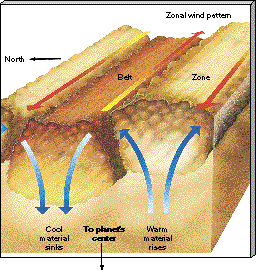 Light Zones = uprising material
Dark Bands = sinking material
Light Zones = uprising material
Dark Bands = sinking material
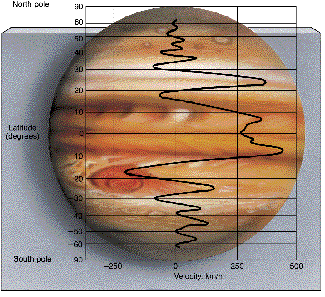
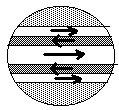 Zonal Flow:
Equator Zone: 300-400 km/hr (Eastward)
N/S Equatorial Belts 100-200 km/hr (Westward)
N/S Tropical Zones 150-300 km/hr (Eastward)
Zonal Flow:
Equator Zone: 300-400 km/hr (Eastward)
N/S Equatorial Belts 100-200 km/hr (Westward)
N/S Tropical Zones 150-300 km/hr (Eastward)
 Great Red Spot
Storm in the Atmosphere
(Strong Coriolis Forces - due to rapid rotation of planet
and high velocity of winds Fcoriolis ~ velocity x angular speed)
(Southern Belt) 15,000 x 25,000 km (twice the size of the Earth)
At present (1998) it is faint and difficult to see.
Rotates Counterclockwise (consistent with adjacent belt flow)
Varies in size and color and visiblity
[300 year old storm - has been observed historically that long]
Other spots (White and Brown) exist
Magnetic Field and Magnetosphere
Measured by Pioneer and Voyagers --
SOURCE = rotating conductive interior (metallic hydrogen in core)
Much stronger and more particles trapped than Earth's Magnetic field
30,000,000 km across (1/5 AU)
Magnetosphere tail > 4 AU (to Saturn's orbit)
Solar Winds compress magnetosphere to 3,000,000 from Jupiter
Io and Plasma Torus
Sodium and Sulfur from Volcanic Io Sweep by faster moving field lines
Io orbit period = 42.5 hours ; Jupiter rotation in 9.8 hours
Distance = 422,000 km (inside magnetosphere)
Current loop along the magnetic field lines to Jupiter
(ionized atoms and electrons)
Satellites: vis
Galilean: Period Orbit Size (dia) Density mag
Io 1.77d 0.422x10⁶km 3630 km 3600 kg/m3 5.0
Europa 3.55 0.671 3140 3000 5.3
Ganymede 7.16 1.070 5260 1900 4.6
Callisto 16.7 1.880 4800 1900 5.6
Moon 27.3 0.384 3480 3340
Viewing : ORBITS Circular INCLINATIONS zero
Galilean Satellites orbits are seen edge on
Jupiter
+ + 0 + +
See "Observer's Handbook" or "Sky and Telescope" Monthly
Diagram of November 1998 Configuration of Jupiter's Satellites
Other Minor Satellites -
Inner satellites 20-100 km diameter
(4) 128-222,000 km radii orbits
Outer satellites 20-170 km diameter
(4) 11.1-11.7 million km radii orbits
Retrograde satellites 20-80 km diameter
(4) 21.2-23.7 million km radii orbits
Jupiter's Ring
Main Ring = thin sheet all the way down to cloud tops
~ 50,000 km above cloud tops (orbit radii = 120,000 km)
-smoke-sized particles averaging 30 m apart
-generated on surfaces of four
inner-most satellites by meteor impacts
Ring Halo = 10 km thick and ~ 3000 km wide
-Just inside inner satellite orbits (Metis orbit at 128,000 km)
Gossamer rings
Out to Thebe's Orbit at 222,000 km
These are effect by the gravity of Amalthea and Adratea
Visitations:
Pioneer 10 Dec 73 Flyby
Pioneer 11 Dec 74 Flyby
Voyager 1 Mar 79 Flyby
Voyager 2 Jul 79 Flyby
Galileo Dec 95 Orbiter and Probe into Jupiter Atmosphere
(see Galileo Animations on CDROM in Chaisson and McMillan)
Great Red Spot
Storm in the Atmosphere
(Strong Coriolis Forces - due to rapid rotation of planet
and high velocity of winds Fcoriolis ~ velocity x angular speed)
(Southern Belt) 15,000 x 25,000 km (twice the size of the Earth)
At present (1998) it is faint and difficult to see.
Rotates Counterclockwise (consistent with adjacent belt flow)
Varies in size and color and visiblity
[300 year old storm - has been observed historically that long]
Other spots (White and Brown) exist
Magnetic Field and Magnetosphere
Measured by Pioneer and Voyagers --
SOURCE = rotating conductive interior (metallic hydrogen in core)
Much stronger and more particles trapped than Earth's Magnetic field
30,000,000 km across (1/5 AU)
Magnetosphere tail > 4 AU (to Saturn's orbit)
Solar Winds compress magnetosphere to 3,000,000 from Jupiter
Io and Plasma Torus
Sodium and Sulfur from Volcanic Io Sweep by faster moving field lines
Io orbit period = 42.5 hours ; Jupiter rotation in 9.8 hours
Distance = 422,000 km (inside magnetosphere)
Current loop along the magnetic field lines to Jupiter
(ionized atoms and electrons)
Satellites: vis
Galilean: Period Orbit Size (dia) Density mag
Io 1.77d 0.422x10⁶km 3630 km 3600 kg/m3 5.0
Europa 3.55 0.671 3140 3000 5.3
Ganymede 7.16 1.070 5260 1900 4.6
Callisto 16.7 1.880 4800 1900 5.6
Moon 27.3 0.384 3480 3340
Viewing : ORBITS Circular INCLINATIONS zero
Galilean Satellites orbits are seen edge on
Jupiter
+ + 0 + +
See "Observer's Handbook" or "Sky and Telescope" Monthly
Diagram of November 1998 Configuration of Jupiter's Satellites
Other Minor Satellites -
Inner satellites 20-100 km diameter
(4) 128-222,000 km radii orbits
Outer satellites 20-170 km diameter
(4) 11.1-11.7 million km radii orbits
Retrograde satellites 20-80 km diameter
(4) 21.2-23.7 million km radii orbits
Jupiter's Ring
Main Ring = thin sheet all the way down to cloud tops
~ 50,000 km above cloud tops (orbit radii = 120,000 km)
-smoke-sized particles averaging 30 m apart
-generated on surfaces of four
inner-most satellites by meteor impacts
Ring Halo = 10 km thick and ~ 3000 km wide
-Just inside inner satellite orbits (Metis orbit at 128,000 km)
Gossamer rings
Out to Thebe's Orbit at 222,000 km
These are effect by the gravity of Amalthea and Adratea
Visitations:
Pioneer 10 Dec 73 Flyby
Pioneer 11 Dec 74 Flyby
Voyager 1 Mar 79 Flyby
Voyager 2 Jul 79 Flyby
Galileo Dec 95 Orbiter and Probe into Jupiter Atmosphere
(see Galileo Animations on CDROM in Chaisson and McMillan)