LECTURE: Nov 4, 1998
Moon and Mercury Temperatures
Transits of Mercury and Venus
Venus Properties
Homework due Monday Nov 16
Chapter 8
Review Question #14
Problems 7, 9
Chapter 9
Review Question #6, 9
Problems 1, 10
Project with ECU
- Determine where Venus is with respect to the Sun
(Elongation) on the following Dates:
Nov 1, 1998
Dec 1, 1998
Jan 1, 1999
Feb 1, 1999
Mar 1, 1999
	Describe where to look for Venus in those coming
months and what it will look like (how bright and where).
Previous Lecture (Moon and Mercury)
Temperatures of the Moon and Mercury:
Mercury: No axial tilt - Slow Rotation (58.7 days) - Cold poles - Hot Equator
No Atmosphere of significance
88 - 700 K
Moon: slow rotation (27.3 days) - small axial tilt - no atmosphere
103 - 383 K (120 C)
Earth: An atmosphere well mixed to equalize temperatures
~ 280 K
Origin of the Moon Impact Theory vs Daughter, Capture, Coelescence
History of Moon Surface Impacting Sequence
Mercury's Surface and Caloris Basin
Large core, thin crust, concentrate shock waves
yield "weird" terrain
Transits of Mercury and Venus:
Mercury 9 May 1970
10 Nov 1973
13 Nov 1986
15 Nov 1999 (6pm local time - sun has set - graze)
May 07 2003 07:52 UT (4:52 ADT)
Nov 08 2006 21:41 UT (18:41 AST)
Venus (at its nodes in June and December -
5 synodic periods = 8 earth years - 2 days
1761
1769 James Cook sent to South Seas to observe this one
to determine the AU (The ship HMS Endevour)
- before 1700, 1 AU was thought to be ~1200 R(Earth)
when actually was 23,455
1874
1882
2004 Jun 08 08:19 UT (5:19 ADT) 10.5' arc from center
2012 Jun 06 01:28 UT ( 9.2' arc from center
8 June 2004 (3 am ADT)
6 June 2012 (9 pm ADT) Both times not visible in Eastern N.America
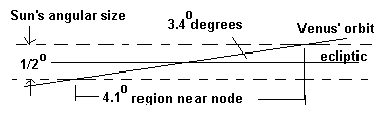 The region of the node of Venus' orbit.
At inferior conjunction Venus is moving 1.6 deg/day in its orbit so
Venus is only in position for a transit for 2.6 days per year.
(1 chance in 140 per Earth year)
Because the orbits of Venus and the Earth are nearly synchronous
with a ratio of 8 to 5, the coincidence does not occur very often.
But when it does then it occurs during two successive identical
configurations, 8 years apart. (shift of 2 days but node region is 2.6 days wide)
The region of the node of Venus' orbit.
At inferior conjunction Venus is moving 1.6 deg/day in its orbit so
Venus is only in position for a transit for 2.6 days per year.
(1 chance in 140 per Earth year)
Because the orbits of Venus and the Earth are nearly synchronous
with a ratio of 8 to 5, the coincidence does not occur very often.
But when it does then it occurs during two successive identical
configurations, 8 years apart. (shift of 2 days but node region is 2.6 days wide)
Venus Physical Properties
Mass 0.82 Mass of Earth
Radius 0.95 R of Earth
Surface Gravity 0.91 g of Earth
Escape Velocity 10.4 km/s
Rotation Period
Siderial 243 days retrograde (East to West)
Synodic 116.7 days (shorter because rotation and
revolution are in opposite directions)
-Note: Synodic period relative to the
Earth is 583.9 days = 5 x (116.7 days)
The same face of Venus faces the Earth at
every inferior conjunction!!!
Mean Surface Temp = 730 K due to a large 'greenhouse effect'
Illustration of radiation balance for Venus - No Greenhouse Effect
Solar Radiation Absorbed = Infrared Radiation Radiated into Space
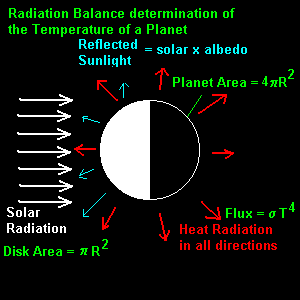 1.
Radiation from the Sun: 1370 W/m2/(0.72)2
F(Sun) = 2642 W/m2
Area of Venus's Disk = (pi)R2
Albedo: a = 0.79 = Fraction of sunlight reflected
Fraction of Sunlight absorbed = 1 - albedo
ISun = Absorbed Sunlight = (1-a) F(Sun)(pi)R2
2.
Infrared radiation Emitted by Venus: F(IR) = s Teff4
Teff = Effective Surface Temperature of Venus
s = Stephan's Constant = 5.67x10⁻⁸ W/m2/K4
Surface Area of Venus = 4(pi)R2
IIR = s Teff4[4(pi)R2]
3.
Determine Teff
IIR = ISun
s Teff4[4(pi)R2] = (1-a) F(Sun)(pi)R2
Teff4 = a F(Sun)/(4 s)
Teff = (0.21 x 2642 W/m2)/(4 x 5.67x10-8 W/m2/K4)
= 222 K
4. Without the Greenhouse effect the surface of Venus would be 222 K.
(Earth based measurements of Temperature at cloud tops = 240 K)
Atmosphere
1. Compositon (CO2 96.5%, N2 3.5%) (Very little H2O 0.015%)!!!!!
2. Dense H2SO4 Clouds
- Sulphuric Acid was detemined with IR spectral reflectance.
- Reflectance drops quickly above 2.8 micrometre
(Note that at 730 K the IR wavelength of blackbody radiation is
2900/730 = 4 micrometre)
IR radiation can not escape the surface
(absorbed by CO2 atmosphere)
3. Thickness of Atmosphere = 50 km compared to 10km for Earth
See figure 9.17
1.
Radiation from the Sun: 1370 W/m2/(0.72)2
F(Sun) = 2642 W/m2
Area of Venus's Disk = (pi)R2
Albedo: a = 0.79 = Fraction of sunlight reflected
Fraction of Sunlight absorbed = 1 - albedo
ISun = Absorbed Sunlight = (1-a) F(Sun)(pi)R2
2.
Infrared radiation Emitted by Venus: F(IR) = s Teff4
Teff = Effective Surface Temperature of Venus
s = Stephan's Constant = 5.67x10⁻⁸ W/m2/K4
Surface Area of Venus = 4(pi)R2
IIR = s Teff4[4(pi)R2]
3.
Determine Teff
IIR = ISun
s Teff4[4(pi)R2] = (1-a) F(Sun)(pi)R2
Teff4 = a F(Sun)/(4 s)
Teff = (0.21 x 2642 W/m2)/(4 x 5.67x10-8 W/m2/K4)
= 222 K
4. Without the Greenhouse effect the surface of Venus would be 222 K.
(Earth based measurements of Temperature at cloud tops = 240 K)
Atmosphere
1. Compositon (CO2 96.5%, N2 3.5%) (Very little H2O 0.015%)!!!!!
2. Dense H2SO4 Clouds
- Sulphuric Acid was detemined with IR spectral reflectance.
- Reflectance drops quickly above 2.8 micrometre
(Note that at 730 K the IR wavelength of blackbody radiation is
2900/730 = 4 micrometre)
IR radiation can not escape the surface
(absorbed by CO2 atmosphere)
3. Thickness of Atmosphere = 50 km compared to 10km for Earth
See figure 9.17
 4. Circulation of the Atmosphere
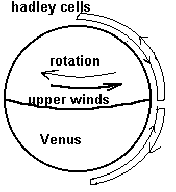 - Hadley Cells extend from the Equator to the Pole
(Earth has 3 Hadley cells)
(Slower Rotation of 243 days versus 1 for the Earth)
Much smaller coriolis Effect in the circulation!!!!
- Very low wind speed on surface 0-2 m/s
- High Circulation speeds above the clouds (50 km) 100 m/s = 360 km/hr
Circles Venus in 4 days
- The cloud pattern shows the swirl at the poles as the air decends
to lower latitudes
5. Greenhouse Effect
79% reflectance (albedo = 0.79)
21% absorbed - (17% by H2SO4 clouds, 2% by CO2, 2% by surface)
CO2 and H2SO4 absorbs the IR radiation and
it can not escape
==> Runaway effect (First Atmosphere with water vapor)
Solar Radiation = 2 x Earth levels
Greenhouse Effect = C02 + H2O --> ~1400K on Surface
- When Venus had an ocean = evaporation
--> more water vapor
--> more greenhouse gas
--> higher temperatures
--> more evaporation
repeat
6. Loss of Water and Formation of secondary atmosphere
- H20 evaporates to atmosphere
- Rises to top of atmosphere
- UV from the Sun dissociates to Hydrogen and Oxygen
- Hydrogen lost from atmosphere (molecular speed > escape velocity)
v(gas) ~ 3 km/s v(escape) = 10 km/s
6x v = 18 km/s > 10 km/s
- CO2 baked out of the rocks = source of C02
[Note: Earth would have atmosphere similar to Venus if all the CO2
were baked out of the Rocks - except for the presence of oxygen]
Surface
Radar imaging of orbiters
(Pioneer, Venera 15 and 16 then Magellan orbiters)
- Hadley Cells extend from the Equator to the Pole
(Earth has 3 Hadley cells)
(Slower Rotation of 243 days versus 1 for the Earth)
Much smaller coriolis Effect in the circulation!!!!
- Very low wind speed on surface 0-2 m/s
- High Circulation speeds above the clouds (50 km) 100 m/s = 360 km/hr
Circles Venus in 4 days
- The cloud pattern shows the swirl at the poles as the air decends
to lower latitudes
5. Greenhouse Effect
79% reflectance (albedo = 0.79)
21% absorbed - (17% by H2SO4 clouds, 2% by CO2, 2% by surface)
CO2 and H2SO4 absorbs the IR radiation and
it can not escape
==> Runaway effect (First Atmosphere with water vapor)
Solar Radiation = 2 x Earth levels
Greenhouse Effect = C02 + H2O --> ~1400K on Surface
- When Venus had an ocean = evaporation
--> more water vapor
--> more greenhouse gas
--> higher temperatures
--> more evaporation
repeat
6. Loss of Water and Formation of secondary atmosphere
- H20 evaporates to atmosphere
- Rises to top of atmosphere
- UV from the Sun dissociates to Hydrogen and Oxygen
- Hydrogen lost from atmosphere (molecular speed > escape velocity)
v(gas) ~ 3 km/s v(escape) = 10 km/s
6x v = 18 km/s > 10 km/s
- CO2 baked out of the rocks = source of C02
[Note: Earth would have atmosphere similar to Venus if all the CO2
were baked out of the Rocks - except for the presence of oxygen]
Surface
Radar imaging of orbiters
(Pioneer, Venera 15 and 16 then Magellan orbiters)
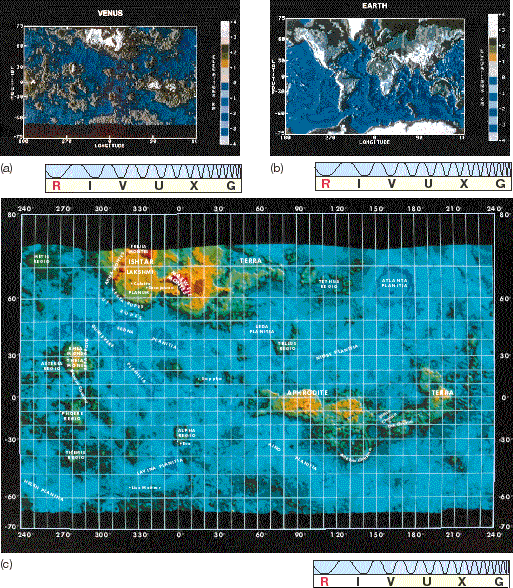 1. Two small 'continents' highland areas (Ishtar and Aphrodite Terra 8% of surface)
compare the Earth with 45% of crust being continental (must include off shore)
Ishtar has Maxwell Mountains (formed by movement of crust)
Topo Map of Venus JPL
2. Few Craters, and only large ones (impacts only 20% of that on Lunar Maria)
(small meteroids can not reach the surface through the thick atmosphere)
Three Craters in Perspective JPL (same as figure 9.14)
3. No Plate Tectonics (But there are volcanic and mantle forces that move the
soft crust) example on the planes near Maxwell Mountains
Destroyed Crater JPL
4. Large Volcanoes (Shield Volcanoes with very viscous lava - broad low volcanoes)
Gula and Sif Mons (south of Maxwell) JPL (fig 9.12)
5. Large Lava Flows from cracks
Drainage Channel JPL
6. Broad Coronae (large raised areas due to pressure from below the crust)
Corona Aine JPL (fig 9.13)
7. Volconic domes of thick lava
Pancake Domes JPL
6. Young Surface ~ 0.5 billion years old - Volcanism resurfaces Venus
Unusual Volcano and Lava Flow JPL
Theory of History of Evolution of Venus' Crust
a) Soft Crust
b) Hotter Mantle
c) Tessera formed where 'plates' collide
(Volcanic expansion pushes soft crust together)
Magnetic field and Solar Winds
No Magnetic field - due to slow rotation (243 times slower than the Earth)
Solar winds and magnetic field deflected by
a highly electrical conductive ionosphere
[ The intense solar radiation ionizes the upper atmosphere to a greater
extent than on Earth ]
1. Two small 'continents' highland areas (Ishtar and Aphrodite Terra 8% of surface)
compare the Earth with 45% of crust being continental (must include off shore)
Ishtar has Maxwell Mountains (formed by movement of crust)
Topo Map of Venus JPL
2. Few Craters, and only large ones (impacts only 20% of that on Lunar Maria)
(small meteroids can not reach the surface through the thick atmosphere)
Three Craters in Perspective JPL (same as figure 9.14)
3. No Plate Tectonics (But there are volcanic and mantle forces that move the
soft crust) example on the planes near Maxwell Mountains
Destroyed Crater JPL
4. Large Volcanoes (Shield Volcanoes with very viscous lava - broad low volcanoes)
Gula and Sif Mons (south of Maxwell) JPL (fig 9.12)
5. Large Lava Flows from cracks
Drainage Channel JPL
6. Broad Coronae (large raised areas due to pressure from below the crust)
Corona Aine JPL (fig 9.13)
7. Volconic domes of thick lava
Pancake Domes JPL
6. Young Surface ~ 0.5 billion years old - Volcanism resurfaces Venus
Unusual Volcano and Lava Flow JPL
Theory of History of Evolution of Venus' Crust
a) Soft Crust
b) Hotter Mantle
c) Tessera formed where 'plates' collide
(Volcanic expansion pushes soft crust together)
Magnetic field and Solar Winds
No Magnetic field - due to slow rotation (243 times slower than the Earth)
Solar winds and magnetic field deflected by
a highly electrical conductive ionosphere
[ The intense solar radiation ionizes the upper atmosphere to a greater
extent than on Earth ]
L.Bogan - Nov 4, 1998